
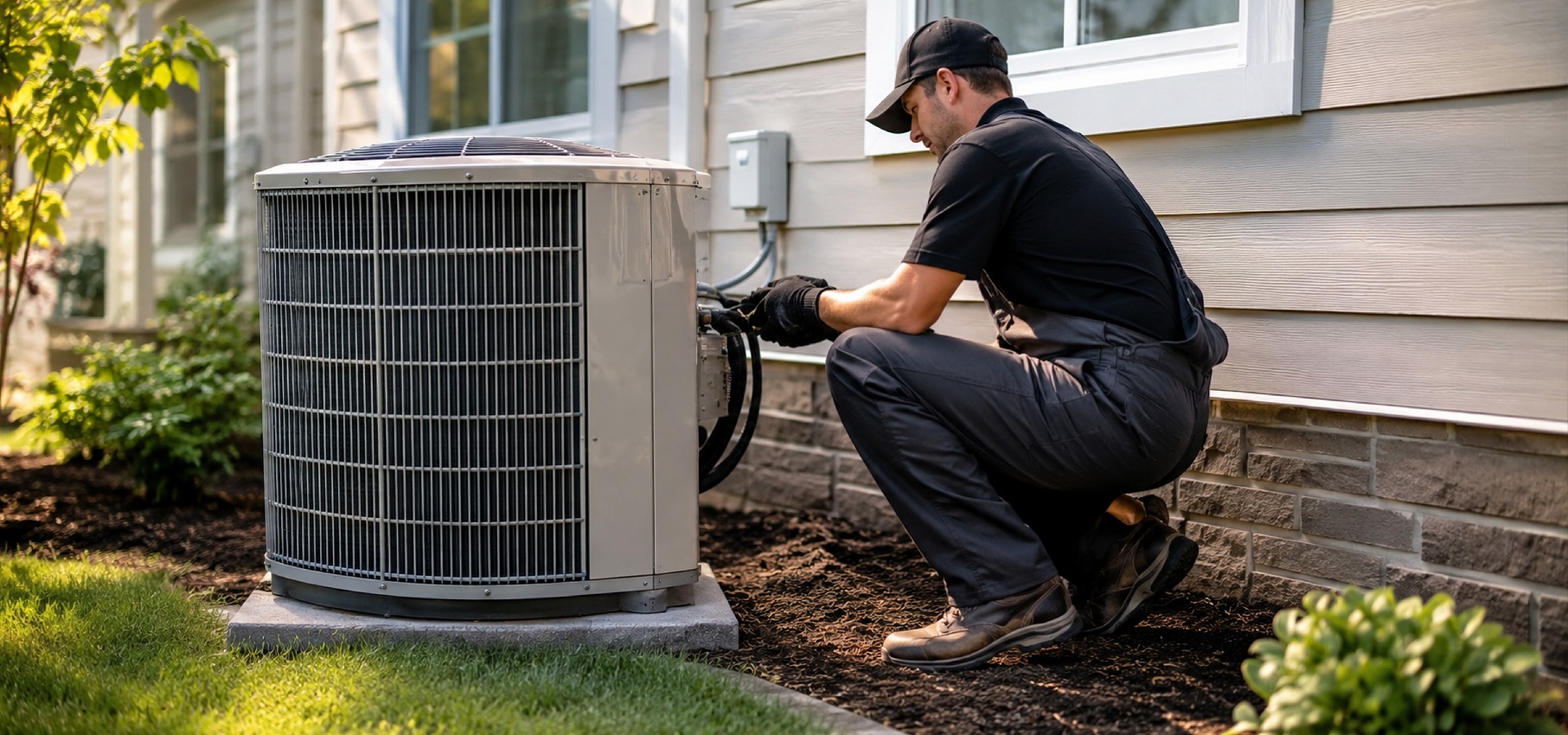
The right air conditioner size depends on your property’s square footage, insulation, ceiling height, window exposure, occupancy, and Canada’s regional climate. While many property owners estimate based on square footage alone, professional HVAC sizing uses BTU requirements and cooling load calculations to ensure comfort, energy efficiency, and lower operating costs.
Choosing an oversized or undersized air conditioner can increase energy bills, reduce indoor comfort, and shorten equipment lifespan. In this guide, you’ll learn how to determine the correct AC size, understand BTU ratings, compare installation costs in Canada, and discover why professional load calculations provide the most accurate results. If your current system is already showing signs of strain, our Air Conditioner Repair Services can help diagnose whether a repair or a proper resize is the right next step.
Air Conditioner Sizing Explained: BTUs, Tonnage, and Performance
Proper air conditioner size relies on accurate BTU calculation and AC tonnage, measured in British Thermal Units (BTU). Cooling capacity depends on the refrigeration cycle, compressor, evaporator coil, condenser, and heat transfer within your HVAC system. Correct HVAC sizing also considers airflow (CFM) and Seasonal Energy Efficiency Ratio (SEER2) for optimal performance.
Understanding BTUs and AC Tonnage
Air conditioner size is measured in BTU capacity and AC tonnage, reflecting heat transfer via the refrigeration cycle. Compressor, evaporator coil, and condenser airflow (CFM) determine cooling output and overall HVAC capacity.
Why Correct Air Conditioner Size Matters
Correct AC sizing improves energy savings, comfort level, and cooling performance while ensuring humidity control, airflow distribution, and system efficiency. Regular Air Conditioner Maintenance protects humidity regulation and indoor air quality year-round.
How Do You Know What Size Air Conditioner You Need?
To know what size air conditioner you need, professionals use the Manual J calculation, factoring building insulation, window orientation, room dimensions, heat gain, insulation value, solar radiation, and ventilation rate within the building envelope. Heat Pump Installation requires similar precise cooling demand assessment.
Quick Sizing Checklist:
- Calculate square footage and room dimensions
- Assess insulation value and building envelope quality
- Evaluate window orientation and solar radiation exposure
- Factor in ventilation rate and occupancy levels
- Apply Manual J calculation for accurate cooling demand
Factors That Affect AC Sizing
Roof insulation, ceiling height, occupancy, and sun exposure directly influence thermal mass, air infiltration, and radiant heat within the conditioned area, making accurate assessment essential for proper AC sizing.
Real-Life Property Owner Example:
A Toronto property owner swapped an oversized AC unit for a properly sized system, cutting electricity bills significantly while achieving noticeably better indoor humidity control year-round.
Common AC Sizing Mistakes
An oversized AC causes short-cycling, poor moisture removal, and wasted energy, while an undersized AC struggles with cooling problems and compressor cycling issues. Both hurt HVAC efficiency and latent heat management. Regular HVAC Maintenance Services help catch sizing-related problems early.
Air Conditioner Size Chart by Space Area
Understanding what size air conditioner your space needs starts with a reliable AC size chart. Air conditioner sizing depends on floor area, heat load, and airflow requirement, but this BTU guide offers a starting point before professional equipment sizing and full HVAC load calculation confirm the right fit. Cooling capacity generally scales with square footage, though insulation, sun exposure, and occupancy can shift the ideal tonnage up or down. For residential and commercial spaces alike, this tonnage chart helps property owners and building managers estimate cooling capacity before booking a professional assessment.

Estimated Air Conditioner Size Chart
The chart below offers an approximate cooling calculation based on HVAC capacity, energy demand, airflow capacity, and sensible heat load for common space sizes:
| Space Area (sq ft) | Approximate BTU Requirement | Approximate Tonnage |
| 500 sq ft AC | 10,000 – 12,000 BTU | 1 ton |
| 700 sq ft | 14,000 BTU | 1.2 tons |
| 1000 sq ft AC | 18,000 – 21,000 BTU | 1.5 – 1.75 tons |
| 1200 sq ft | 24,000 BTU | 2 tons |
| 1500 sq ft AC | 28,000 – 30,000 BTU | 2.5 tons |
| 2000 sq ft | 34,000 – 36,000 BTU | 3 tons |
| Office air conditioning (2500+ sq ft) | 40,000+ BTU | 3.5+ tons |
These figures serve as a general commercial AC sizing and residential reference only. Actual airflow capacity and energy demand vary based on ceiling height, insulation quality, window exposure, and occupancy, which is why a full HVAC load calculation from a professional remains the most accurate way to confirm your ideal system size.
How to Choose the Right Air Conditioner Size
Choosing the right air conditioner size starts with an AC sizing guide covering room or building size, ceiling height, occupancy, and heat-generating equipment. Sun exposure, insulation, and ventilation all influence cooling load, while a professional Manual J calculation remains the most reliable way to confirm HVAC sizing. Solar heat gain, airflow, and overall HVAC efficiency vary from property to property, so estimates based on square footage alone often miss the mark. Energy efficiency also plays a role in right-sizing: factors like Seasonal Energy Efficiency Ratio (SEER2), heat gain and cooling load, proper insulation, smart thermostat optimisation, and air sealing and duct efficiency all affect how much cooling capacity your building actually needs.

Common Air Conditioner Sizing Myths
Bigger ACs cool better — oversized units actually cool unevenly and leave excess humidity behind. Every 2,000 sq ft property needs the same unit — layout, insulation, and sun exposure change requirements. Square footage is all that matters — it’s only one factor among many. Bigger BTU ratings mean lower bills — oversized systems often waste energy cycling frequently. Window AC sizing applies to central systems — the two use entirely different calculation methods.
Cooling Needs in Toronto, Calgary and Vancouver
Canadian weather varies by region — Toronto’s continental climate, Calgary’s prairie climate, and Vancouver’s coastal climate each create different cooling loads and AC sizing requirements for residential and commercial properties.
Comparison: Regional Cooling Needs Across Canada
| City | Climate Type | Typical Cooling Load Considerations |
| Toronto | Continental climate | Humid summers increase latent heat load; higher SEER2 ratings help offset high moisture-removal demand |
| Calgary | Prairie climate | Dry heat and strong solar heat gain through south-facing windows call for careful insulation and shading |
| Vancouver | Coastal climate | Milder seasonal temperature swings mean smaller cooling loads, but airflow and ventilation still matter for comfort |
Across all three regions, pairing correct HVAC sizing with strong energy efficiency practices, proper insulation, air sealing and duct efficiency, and smart thermostat optimisation — helps occupants get consistent comfort without oversizing equipment or inflating energy bills. Following ENERGY STAR Canada efficiency recommendations when selecting a system further ensures long-term savings and reliable year-round performance.
Canadian Climate Considerations for AC Sizing
Canada’s diverse climate affects AC sizing significantly — Ontario’s humidity increases latent cooling loads, Alberta’s dry summers demand different moisture handling, and BC’s coastal climate adds humidity challenges. Prairie temperature swings and Atlantic Canada’s seasonal moisture further influence requirements. NRCan, ENERGY STAR Canada, and HRAI all recommend climate-specific sizing for optimal efficiency.
HVAC Expert Tip:
It might feel safer to size up “just in case,” but going bigger often backfires. An oversized AC cools the space fast without giving humidity enough time to be removed, leaving you with air that feels cold yet damp rather than truly comfortable.
FAQ
Q1. What size air conditioner do I need for a 2,000 sq ft house?
A 2,000 sq ft Canadian property may require approximately 30,000–42,000 BTUs (2.5–3.5 tons), depending on insulation, climate, ceiling height, and window exposure. A professional load calculation provides the most accurate recommendation.
Q2. Can I choose an air conditioner based only on square footage?
No. Square footage provides only a starting point. Factors such as insulation quality, windows, occupancy, ceiling height, and Canada’s climate significantly influence the correct air conditioner size.
Q3. Is a bigger air conditioner always better?
No. An oversized AC cools too quickly, leading to poor humidity control, higher energy consumption, and increased wear. Proper sizing delivers better comfort and efficiency.
Q4. How much does a new air conditioner cost in Canada?
Property owners in Canada typically spend between CAD $4,500 and CAD $9,500 for a professionally installed central air conditioner, depending on capacity, home size, and installation complexity.
Q5. Why should an HVAC professional calculate my AC size?
HVAC professionals evaluate insulation, windows, airflow, occupancy, and local climate to recommend the ideal system size. This improves comfort, efficiency, and long-term operating costs.
Key Takeaways
Getting your AC size right from the start is key to long-term comfort, efficiency, and savings in a Canadian residential or commercial property.
- AC size depends on more than square footage.
- Manual J calculations provide the most accurate sizing.
- Oversized and undersized systems both reduce efficiency.
- Canadian climate influences cooling requirements.
- Professional sizing improves comfort, lowers energy costs, and extends equipment lifespan.
CONCLUSION
Selecting the right air conditioner size is essential for comfort, lower energy bills, and reliable performance in Canada’s diverse climate. A professional sizing assessment helps you avoid costly mistakes and maximise efficiency.
Ready to upgrade your property’s cooling? Get a free quote, book a consultation, and speak with our HVAC experts today.