
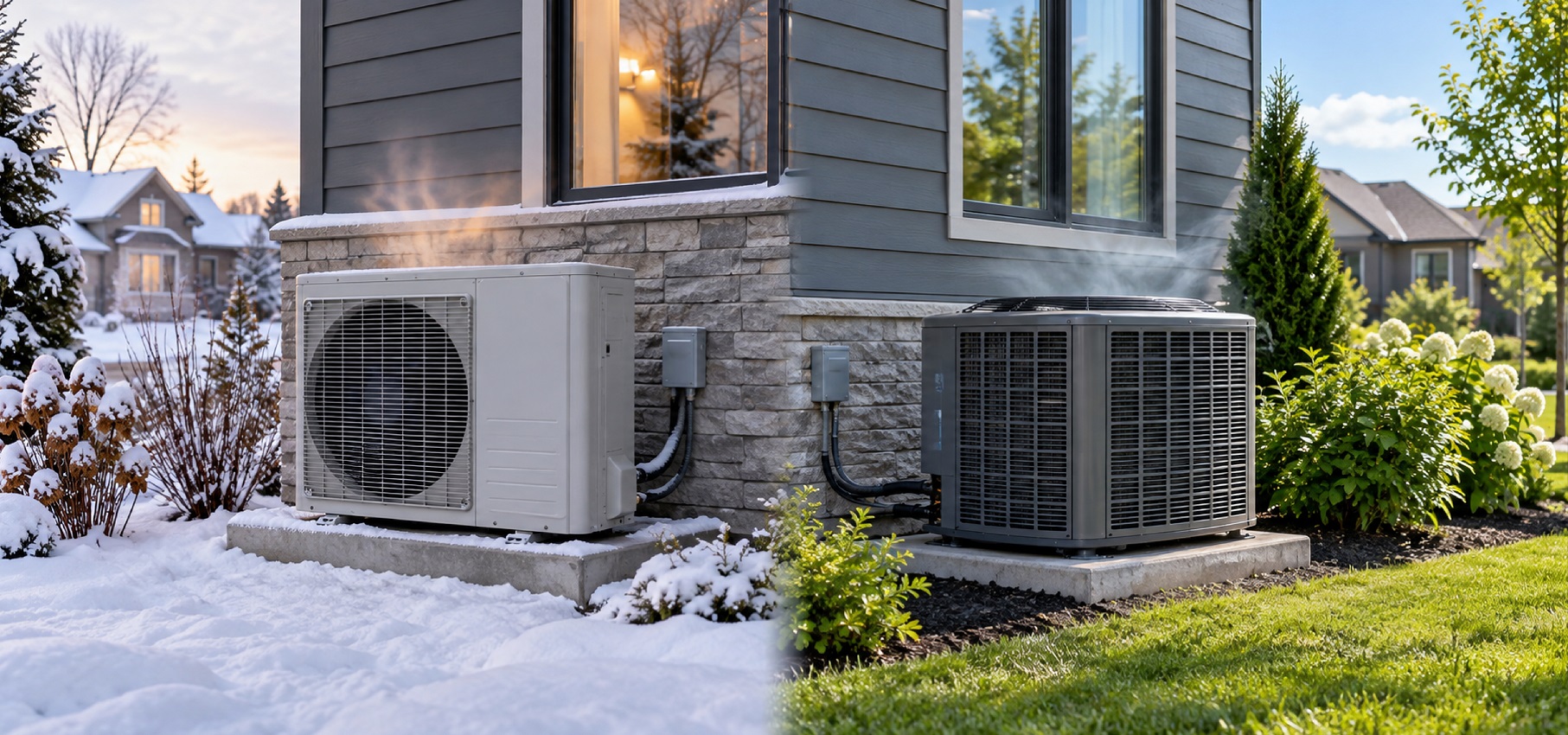
A heat pump and air conditioner both provide cooling, but a heat pump can also reverse its refrigerant cycle to provide heating. This makes heat pumps a more versatile option for many Canadian homes, while a central AC system is primarily designed for summer cooling.
Both systems rely on the same refrigeration cycle to remove heat from indoor air and release it outdoors, which is why they look similar and share core components. The key difference is reversibility: an air conditioner moves heat one way only out of the home while a heat pump can reverse the process, drawing heat from outdoor air and bringing it indoors, even in cold weather.
This distinction matters more in Canada than in milder climates, where homeowners often need reliable heating for much of the year alongside summer cooling. Choosing between a heat pump vs AC unit involves weighing installation cost, operating costs, year-round efficiency, and cold-weather performance.
How Do Heat Pumps and Air Conditioners Work?
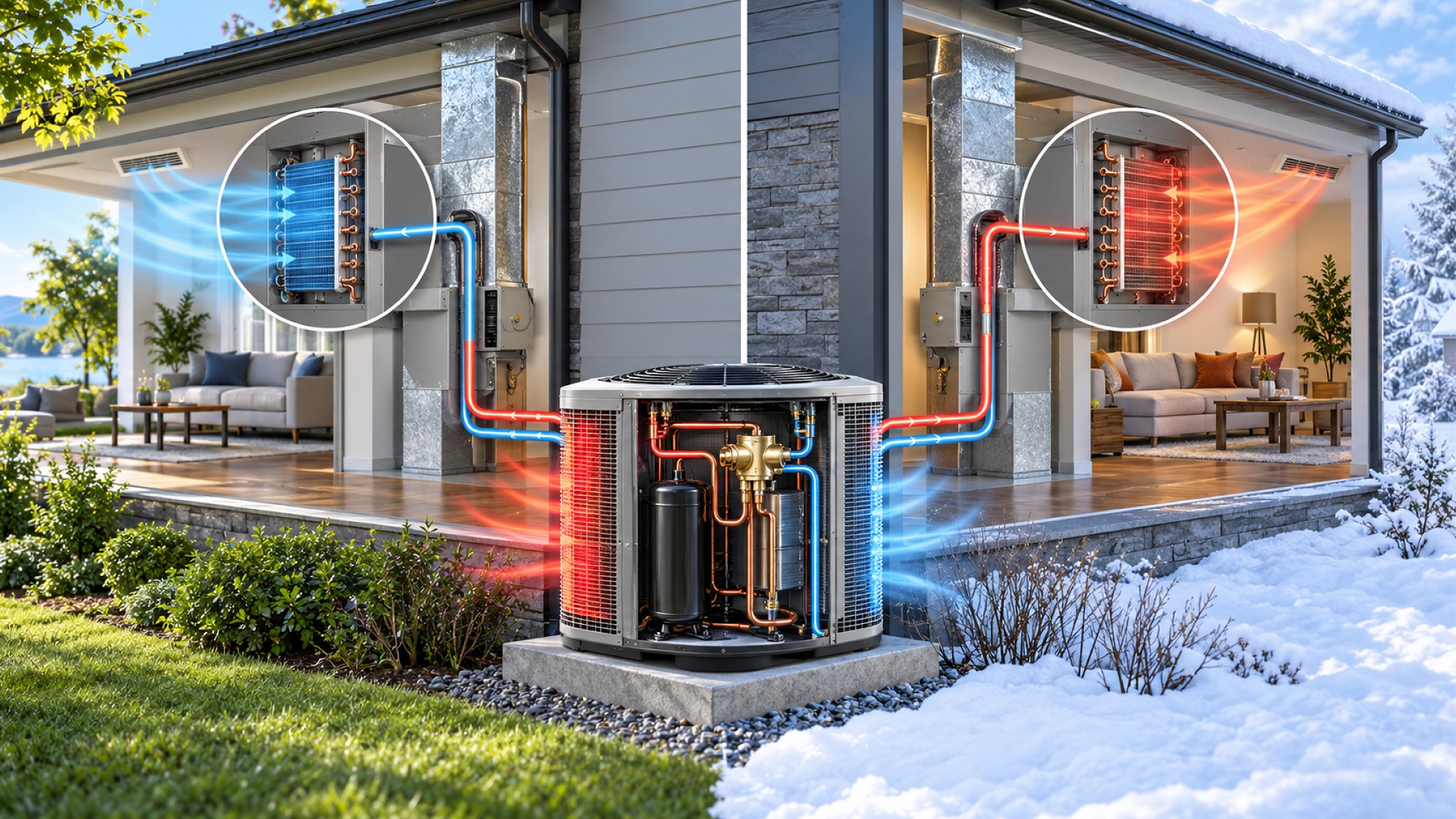
Both systems use refrigerant to move heat, but only one of them can run that heat transfer process in reverse.
How Does an Air Conditioner Work?
An air conditioner uses a compressor, condenser coil, evaporator coil, and refrigerant to move heat. Indoor air passes over the evaporator coil, where refrigerant absorbs heat, cooling the air before it circulates back inside. The compressor then pushes that heat to the outdoor condenser coil, where it’s released outside.
How Does a Heat Pump Work?
A heat pump uses the same cycle but adds a reversing valve, enabling reversible heating and cooling from a single system. In cooling mode, it works like an AC. In heating mode, the valve reverses the cycle, so the outdoor coil extracts heat from outdoor air even in cold weather and the indoor coil releases it inside.
How Are Heat Pumps and Air Conditioners Similar?
In a heat pump vs ac comparison, the two systems share more than they differ on.
Shared characteristics include:
- ✅ Both use a compressor, condenser coil, and evaporator coil to move heat
- ✅ Both integrate into ducted central systems for whole-home cooling capacity
- ✅ Both require similar maintenance, including filter changes and coil cleaning
- ✅ Both need correct sizing to match a property’s layout and support indoor comfort
- ✅ Both require professional installation for proper airflow and refrigerant charge
Shared Components and Functions
Both systems use an outdoor unit with a compressor and condenser, linked via refrigerant lines to an indoor coil and air handler. The blower motor pushes conditioned air through the ductwork. Because these components overlap, AC installation services and AC repair services apply similar expertise across both heat pumps and traditional air conditioners.
Heat Pump vs Air Conditioner: Cost and Energy Efficiency
Heat pump vs AC cost isn’t one universal price — it depends on the property, existing HVAC setup, and year-round usage.
Heat pump installation typically costs more upfront, since it handles both heating and cooling with added components like a reversing valve. An air conditioner only manages cooling, keeping equipment cost lower.
Operating costs vary too. A heat pump’s cost depends on climate, electricity rates, and backup heating needs. An AC only covers cooling, so a separate furnace is still required for heating.
Cost and efficiency comparison:
| Cost Factor | Heat Pump | Air Conditioner |
| Equipment cost | Usually higher | Usually lower |
| Installation | Depends on existing HVAC | Depends on existing HVAC |
| Heating capability | Yes | No |
| Cooling capability | Yes | Yes |
| Heating operating cost | Depends on climate, electricity and backup system | Requires separate heating |
| Long-term value | Potentially higher due to dual function | Primarily cooling |
When it comes to energy efficiency, heat pumps are often rated using both a seasonal energy efficiency ratio (SEER) for cooling and a coefficient of performance (COP) for heating, since electrical heating via a heat pump can be more efficient than resistance-based heating in moderate conditions. Because a heat pump runs year-round rather than seasonally, its overall energy consumption and long-term energy savings depend heavily on local climate and how well it’s sized to the property.
As a general CAD pricing framework, heat pump installation costs tend to run higher than a comparable AC installation, though exact figures vary significantly by room size, system capacity, ductwork condition, and installation complexity. These figures should be treated as estimates only, not fixed Proton HVAC pricing — a property-specific assessment through our Calgary HVAC Services is the most reliable way to get accurate numbers.
Which Is Better for Canada: Heat Pump or AC?
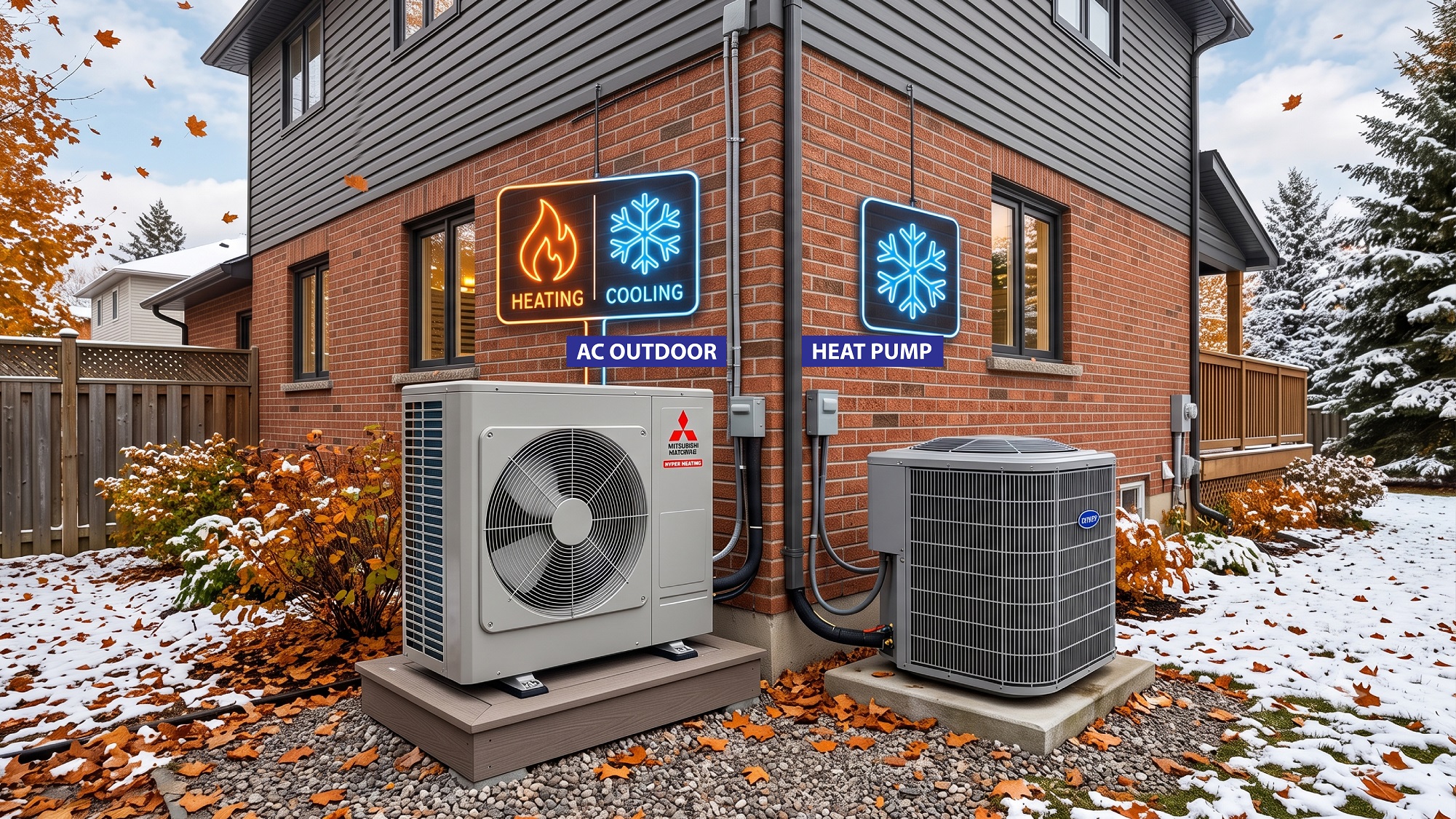
Choosing between a heat pump and AC depends on the Canadian climate, heating requirements, existing HVAC setup, and year-round comfort needs. Use the following checklist to determine which option may be more suitable:
- ✅ Canadian climate, heating needs, and existing HVAC setup
- ✅ Heat pump provides year-round heating and cooling
- ✅ Handles both heating load and cooling load with one system
- ✅ Cold-climate heat pump performance in low temperatures
- ✅ Supplemental heating may be needed in extreme cold
- ✅ AC paired with a separate furnace for homes with reliable winter heating
- ✅ Alberta: strong cold-climate heating performance is important
- ✅ Ontario: balanced heating and cooling needs
- ✅ British Columbia: milder climate suited to heat pumps
- ✅ Quebec: cold winters require careful consideration of heating performance
Heat Pump May Be Suitable If You Want
- ✅ Year-round comfort from one dual-purpose HVAC system
- ✅ Efficient heating alongside cooling in the same unit
- ✅ Electric heating, potentially with lower operating costs than resistance heating
- ✅ Strong heating capacity even during colder months, with proper sizing
Air Conditioner May Be Suitable If You Want
- ✅ A dedicated summer cooling solution
- ✅ To keep an existing furnace for winter heating
- ✅ A cooling-only system with lower upfront equipment cost
- ✅ Central air conditioning that integrates easily into ducted HVAC already in place
What Should Canadian Property Owners Consider When Choosing a Heat Pump vs AC Unit?
Choosing between a heat pump vs AC unit involves several practical factors specific to the property, not just the system itself.
Key considerations checklist:
- ✅ Room size and heating/cooling load — Larger spaces or homes with higher room heating requirements need properly sized equipment to maintain comfort
- ✅ Existing furnace and ductwork — Compatible ductwork can simplify installation, while retrofit considerations matter more when replacing an older system
- ✅ Climate and winter temperatures — Colder regions demand stronger cold-weather heating capacity from a heat pump
- ✅ Electricity and energy costs — Local utility costs affect long-term operating expenses for either system
- ✅ Installation requirements — Electrical capacity, ductwork condition, and building envelope all influence installation complexity
- ✅ Available rebates or incentives — Some Canadian regions offer incentives that can offset heat pump installation costs
- ✅ Long-term comfort and operating priorities — Year-round dual-function comfort vs. simpler cooling-only operation
Climate Considerations Across Canada
Heating degree days and cooling degree days vary significantly by region, shaping how a system performs seasonally. Alberta winters bring high heating degree days and strong seasonal demand for reliable heating capacity. Per NRCan, COP declines as temperatures drop, which is why cold-climate models matter most in Alberta and Quebec. Ontario climate sees a more balanced mix of heating and cooling needs across the year. British Columbia weather is generally milder, reducing extreme cold climate demands on heating capacity. Quebec’s long heating season places similar demands on system performance as Alberta.
For heat pump owners needing ongoing support through any of these climates, our Heat Pump Repair Services team can help keep systems performing reliably year-round.
Calgary example: A Calgary homeowner comparing a heat pump with an existing AC and furnace may evaluate cold-weather performance, backup heating needs, electricity costs, and the age of their existing equipment before deciding whether to upgrade or replace.
Heat Pump vs Air Conditioner: Which One Should You Choose?
When it comes to air conditioner vs heat pump decisions, a concise framework helps: weigh upfront investment against year-round functionality, factor in your property’s specific needs, and involve a professional before committing to HVAC system selection.
Decision checklist:
- ✅ Upfront investment vs. long-term function — A heat pump typically costs more initially in CAD pricing but delivers both heating and cooling from one system, while an air conditioner keeps upfront costs lower but requires a separate heating source
- ✅ Climate demands — Colder regions call for cold-climate heat pump technology capable of handling extreme winter conditions
- ✅ Existing HVAC setup — Compatible ductwork and electrical capacity affect whether heat pump installation or AC installation is more straightforward
- ✅ Room comfort and system sizing — Every property has different room characteristics, so accurate system sizing is essential for either option to perform well
- ✅ Electricity and Canadian energy-efficiency considerations — Canadian electricity costs and available federal or provincial rebates, where currently applicable, can shift the long-term value equation.
- ✅ Professional assessment — A proper indoor climate control evaluation ensures the right system is chosen and correctly sized for the home
It’s worth noting that federal rebate programs for heat pumps have changed recently — the Canada Greener Homes Grant is no longer accepting new applications, according to Natural Resources Canada. Homeowners should check current provincial programs and NRCan’s site directly for the latest available incentives.
Because sizing and building-specific factors so heavily influence performance, a professional HVAC assessment remains the most reliable way to determine whether a heat pump or central air conditioner is the better fit — something the Proton HVAC team can help evaluate directly, whether the property is a straightforward cooling upgrade, a routine AC Maintenance Services check, or a full heating and cooling season overhaul.
FAQ
Q1. Does a heat pump work below freezing in Canada?
Yes, a cold-climate heat pump can operate below freezing, though heating capacity declines as outdoor temperature drops. The defrost cycle and supplemental heat help maintain COP and comfort in extreme cold.
Q2. Can a heat pump replace both an AC and furnace?
Yes, a heat pump system provides both space heating and a cooling cycle, functioning as dual heating and cooling equipment. Some Canadian homes pair it with backup heat for extreme cold.
Q3. How much maintenance does a heat pump need compared with an air conditioner?
Heat pump maintenance is similar to AC maintenance — both need seasonal servicing, air filter changes, and outdoor coil inspection. Heat pumps run year-round, so preventative maintenance matters slightly more.
Q4. How long does a heat pump typically last compared with an air conditioner?
Heat pump and AC lifespans are generally comparable, though year-round heat pump use can affect compressor and outdoor unit durability more than seasonal-only air conditioning system components over their equipment lifecycle.
Q5. Can I switch from an air conditioner to a heat pump?
Yes, AC replacement with a heat pump conversion is common. Existing ductwork often works, though electrical capacity and heating system compatibility should be assessed before heat pump installation begins.
CONCLUSION
Both heat pumps and air conditioners provide effective cooling, so the choice often comes down to one key distinction: a heat pump can also provide heating, while a standard AC cannot. Beyond that, Canadian climate, existing HVAC equipment, installation requirements, and long-term operating costs should all factor into the decision for a specific property.
Get a free quote, book a consultation, or speak with our HVAC experts today for a full system assessment tailored to your home or commercial property.