

A humidifier adds moisture to dry indoor air and can improve winter comfort in Canadian residential and commercial properties. When heating systems run through cold weather, they draw in cold outdoor air with low moisture content and warm it, which lowers relative humidity indoors even further, leaving air noticeably drier than outside.
Key winter benefits include more comfortable skin and airways, reduced static electricity, improved perceived warmth at lower thermostat settings, better protection for wood flooring and furniture, and more balanced indoor humidity overall. That said, these benefits depend on maintaining an appropriate humidity level rather than simply adding as much moisture as possible over-humidifying brings its own problems.
Relevance also varies regionally: Calgary and Alberta’s cold, dry winters typically demand more humidification than British Columbia’s milder, more humid coastal conditions. Choosing the right humidifier type and target humidity setting matters just as much as installing one.
What Are the Benefits of a Humidifier in Winter?
Winter humidification adds moisture back into indoor air during the heating season, offsetting the drying effect of forced-air heating. As furnaces warm cold, low-moisture outdoor air, indoor relative humidity drops further, leaving winter air noticeably drier than comfortable. These benefits are comfort measures, not health treatments — a humidifier doesn’t prevent or cure illness. Balanced humidity matters for both residential and commercial properties alike.
1. Helps Relieve Dry Indoor Air
Heated air holds less water vapour relative to its temperature, which is why indoor dryness becomes more noticeable in winter. A humidifier helps restore relative humidity to a more balanced range, easing common dry-air symptoms like dry skin, irritated sinuses, and scratchy throats caused by moisture deficiency in heated indoor air.
2. Can Make Indoor Spaces Feel More Comfortable
Humidity affects perceived temperature — air with more moisture tends to feel warmer at the same thermostat setting due to how humidity regulation influences heat transfer and thermal comfort. This can support more consistent indoor climate control through the winter season, even without adjusting the heating system itself.
3. Helps Reduce Static Electricity
Dry winter air is a major contributor to static shocks, since low relative humidity allows electrical charge to build up more easily on surfaces and clothing. Adding moisture to the indoor environment helps reduce this static electricity, making everyday winter static less of a nuisance.
4. Helps Protect Wood and Furnishings
Wood furniture, flooring, and other wooden building materials respond directly to changes in wood moisture content. Overly dry air can cause wood shrinkage, warping, or cracking over time. Maintaining better moisture balance helps support the dimensional stability of these materials through the heating season.
Energy Efficiency Considerations
Humidification shouldn’t be marketed as a guaranteed energy-saving measure. While improved comfort may allow some households to feel comfortable at a lower thermostat setting, this is a comfort and humidity-management outcome, separate from measurable HVAC efficiency. Overall energy performance still depends primarily on HVAC system efficiency and building envelope quality.
Overall energy performance still depends primarily on HVAC efficiency and building envelope quality, not humidification alone. Homeowners can explore Humidifier HVAC Services for proper sizing and installation.
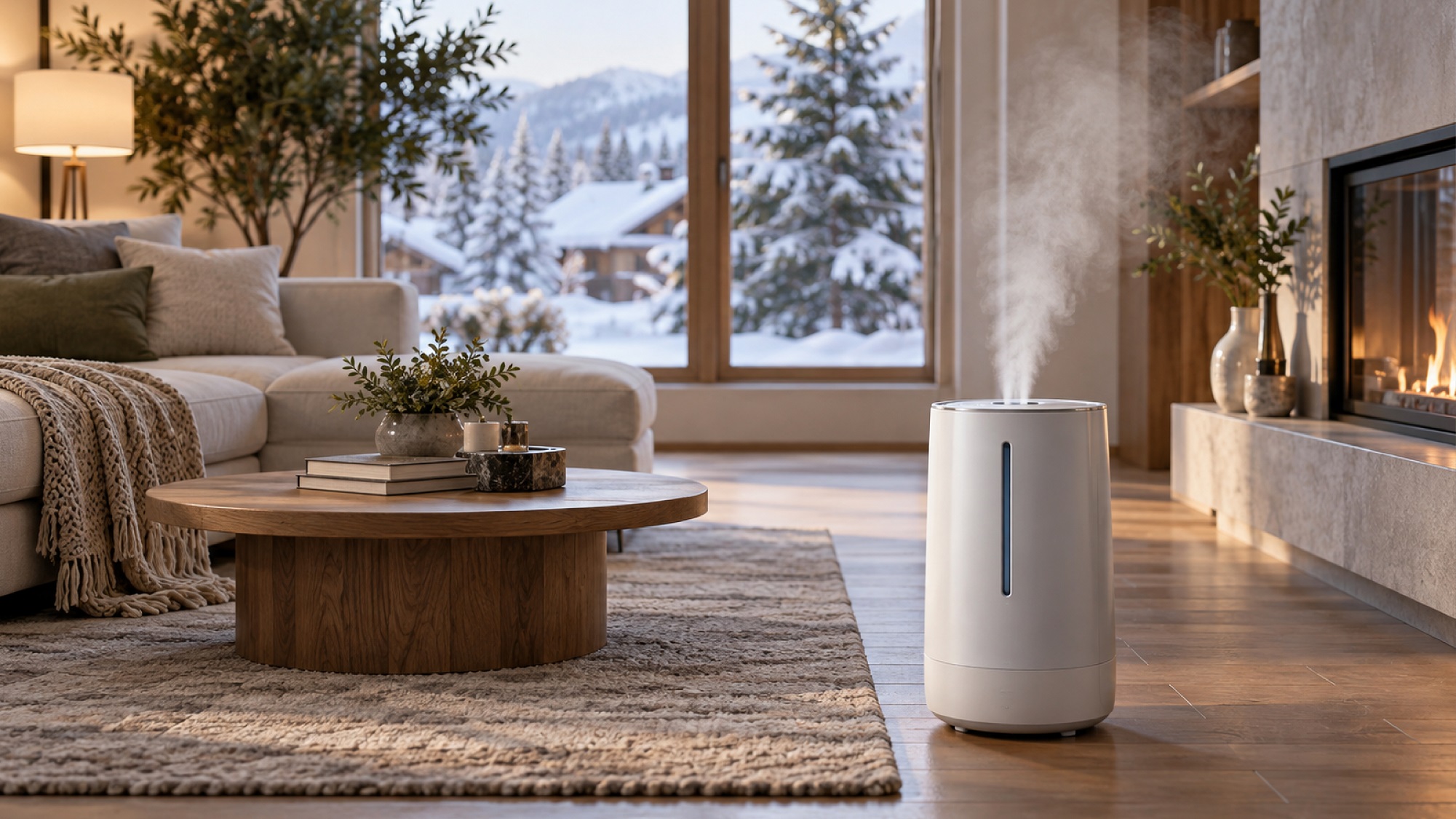
How Does a Humidifier Improve Winter Indoor Comfort?
The humidification process works by introducing water vapour into conditioned air as it moves through a home’s heating system, raising the indoor humidity level without altering the air’s temperature directly. This moisture control happens continuously as air circulates, helping counter the drying effect that forced-air furnaces have on indoor air during winter.
How Humidification Works With a Heating System
A furnace humidifier is typically integrated with the forced-air furnace, adding water vapour to heated airflow before it moves through the duct system. As air circulates via normal ductwork, the humidification equipment releases moisture into that airflow, reaching rooms throughout the property without a separate distribution step.
Why Humidity and Temperature Work Together
Humidity and temperature are related but distinct temperature measures how warm air is, while relative humidity measures how much moisture it holds. Since moist air affects heat transfer and thermal comfort, a suitable humidity setting often makes a space feel warmer at the same temperature, without raising the thermostat.
It’s worth noting that more humidity isn’t automatically better — excessive humidity can create separate problems like condensation or mould risk. Maintaining balanced humidity, not maximizing it, is what actually supports comfort. For homes managing both moisture and air quality together, our Indoor Air Quality Services can help assess what’s right for your property.
What Humidity Level Is Best for Canadian Winters?
A commonly cited starting point for indoor relative humidity during winter falls somewhere between 30–35%, though this range isn’t a fixed rule — the ideal setting depends on outdoor temperature, building envelope performance, and condensation risk at that specific property. In very cold conditions, a lower indoor humidity may actually be necessary to avoid window condensation, since colder glass surfaces reach the dew point more easily even at moderate humidity levels.
Canadian winter conditions and humidity considerations:
| Canadian Winter Condition | Humidity Consideration |
| Very cold outdoor temperatures | Lower indoor humidity may be necessary |
| Moderate winter temperatures | Moderate humidity setting |
| Cold windows | Monitor for condensation |
| Well-insulated building | Potentially better humidity retention |
| Poorly insulated building | Greater condensation risk |
Regional differences matter: Calgary and Alberta’s dry cold demands more active humidity management than coastal BC. Ontario and Quebec share similar condensation risks. No single humidity percentage suits every building.
Signs Your Indoor Humidity May Be Too Low
Low relative humidity often shows up as dry skin, a dry throat, frequent static shocks, and cracked or shrinking wood furniture or flooring. If dry indoor air is a recurring winter complaint, it may indicate moisture content indoors has dropped below a comfortable range.
Signs Your Humidity May Be Too High
Excess moisture typically appears as window condensation, damp surfaces, or a musty smell that can signal mould risk. Since condensation forms once air reaches its dew point, visible moisture accumulation on windows or walls is often the clearest early warning of excessive humidity.
Calgary example: A Calgary property facing cold winter conditions and frequent heating use noticed low indoor relative humidity, along with static and dryness complaints from occupants. A humidifier assessment identified the correct humidity setting for the space, followed by routine follow-up maintenance to keep levels balanced through the season.
Which Type of Humidifier Is Best for a Residential or Commercial Property?
Choosing the right humidifier comes down to matching the technology to the property’s size, HVAC setup, and humidity demands. For most homes, a whole-property humidifier integrated with the existing HVAC system offers more consistent results than treating individual rooms, though the right type still depends on the specifics of the building.
Humidifier types compared:
| Humidifier Type | Best For | Key Advantage | Main Consideration |
| Bypass | Residential properties | Simple HVAC integration | Requires airflow |
| Fan-powered | Larger residential spaces | Higher moisture output | Uses additional electricity |
| Steam | High-demand applications | Precise humidity control | Higher installation and operating requirements |
| Portable | Single rooms | Easy placement | Limited coverage |
A bypass humidifier uses the furnace’s existing airflow, keeping installation simple, though performance ties to furnace runtime. A fan-powered humidifier uses its own fan for higher moisture output, better for larger spaces, at the cost of extra electricity. A steam humidifier offers the most precise control, suited to high-demand applications, but requires more installation and operating investment. Portable units suit single rooms with easy placement but limited coverage.
Capacity, water usage, and maintenance vary by unit and property size — larger or drier spaces need higher-capacity systems and more frequent servicing. HVAC-system compatibility matters too, since not every humidifier integrates with every furnace or ductwork setup. A professional assessment — alongside solutions like HRV installation where ventilation is also a concern — helps determine the right fit for a residential or light-commercial property.
How Much Does a Whole-Property Humidifier Cost in Canada?
Humidifier cost for a whole-property system depends on several factors the humidifier type selected, property size, existing ductwork, and how compatible the installation is with the current HVAC system. Because these variables shift from property to property, pricing is best treated as an indicative range rather than a guaranteed quote.
Cost factors to consider:
| Cost Factor | Indicative Canadian Consideration |
| Equipment | Varies by humidifier technology and capacity |
| Installation | Depends on ductwork and HVAC configuration |
| Maintenance | Water panels, cleaning and inspection may be required |
| Operating cost | Depends on technology, usage and water/electricity consumption |
| Savings potential | Primarily related to comfort and appropriate humidity management rather than guaranteed energy savings |
As a general market benchmark, whole-house humidifier installation in Canada typically ranges from roughly CAD 500–1,500, including the unit and installation. Actual pricing varies significantly by humidifier type, home size, and installation complexity this figure is a general reference point only, not Proton HVAC’s quoted pricing.
Given how much equipment, ductwork, and HVAC compatibility can vary between properties, a property-specific assessment remains the most reliable way to get an accurate installation cost and maintenance cost estimate for your specific home or commercial space.
Are Humidifiers Worth It During Canadian Winters?
Yes, humidifiers can be worthwhile during Canadian winters, particularly in cold, dry climates. Their value depends on outdoor humidity, indoor conditions, furnace use, and how well the humidifier is managed.
- ✅ Cold, dry Canadian climates can benefit most from humidification during winter
- ✅ Furnaces running frequently can make indoor air feel especially dry
- ✅ Calgary and Alberta often experience frigid, low-humidity winters, increasing the need for added indoor moisture
- ✅ Properly managed humidifiers can improve winter comfort when indoor humidity is too low
- ✅ More humid regions may have less need for additional humidification
- ✅ Parts of coastal British Columbia naturally have higher ambient moisture, so aggressive humidification may not be necessary
- ✅ The right humidity level depends on relative humidity levels, outdoor conditions, and the home’s HVAC setup
- ✅ Humidification is a climate-dependent decision, rather than a one-size-fits-all HVAC upgrade
When a Humidifier May Be a Good Choice
A humidifier is worth serious consideration if any of these sound familiar:
- ✅ Dry winter air is a near-daily complaint in the house
- ✅ Static shocks have become a running joke every time you touch a doorknob
- ✅ Furniture, flooring, or trim are visibly drying out, cracking, or shrinking
- ✅ The heating system runs constantly, yet the home still feels uncomfortable
- ✅ Skin, sinuses, or throat dryness spike noticeably once winter sets in
Addressing these issues is really about restoring proper humidity regulation and moisture regulation to support better indoor climate control through the season.
When Professional Assessment Is Recommended
A humidifier isn’t always the right first move. If windows show condensation or there’s a broader moisture imbalance, adding humidity could make things worse. A professional HVAC assessment including a ductwork inspection and a look at the building envelope and ventilation system should come first in these cases.
Humidification works best alongside good ventilation, HVAC maintenance, and a healthy building envelope not as a standalone fix for every winter comfort complaint.
FAQ
Q1. Can you use a humidifier while a furnace is running?
Yes — a furnace humidifier is designed to work alongside forced-air furnace operation, using bypass or steam methods to add moisture into ductwork as the HVAC system distributes heated air throughout the property.
Q2. Can a humidifier help protect hardwood floors and wooden furniture?
Yes — maintaining stable wood moisture content helps prevent dimensional stability issues like shrinking, warping, or cracking in hardwood flooring and wooden furniture, which are common in overly dry winter indoor environments.
Q3. Does a humidifier improve indoor air quality?
A humidifier primarily addresses moisture balance rather than removing airborne particles, so it complements indoor air quality efforts through humidity regulation but doesn’t replace filtration or proper ventilation for overall air quality management.
Q4. Can a humidifier help with dry skin and irritated airways?
Yes — restoring relative humidity to a comfortable range can ease dry skin and support mucous membranes, reducing common winter dryness symptoms like irritated airways, though results vary by individual and humidity setting.
Q5. How does a whole-property humidifier differ from a portable humidifier?
A central humidification system integrates with the HVAC distribution system, humidifying air throughout the property via ductwork, while a portable humidifier treats a single room independently, offering less overall coverage.
CONCLUSION
Humidification can meaningfully improve winter comfort when indoor air becomes excessively dry from prolonged heating system use, easing dryness, static, and strain on wood furnishings alike. The real benefit, though, comes from getting the details right — correct humidity levels, suitably sized equipment, and professional installation matched to the property’s HVAC setup. In Canada’s cold-weather climate, where furnaces run for months at a stretch, humidification is a practical extension of good HVAC management rather than a standalone fix.
Get a free quote, book a consultation, or Schedule HVAC Service to speak with our HVAC experts today about the right humidification solution for your residential or commercial property.